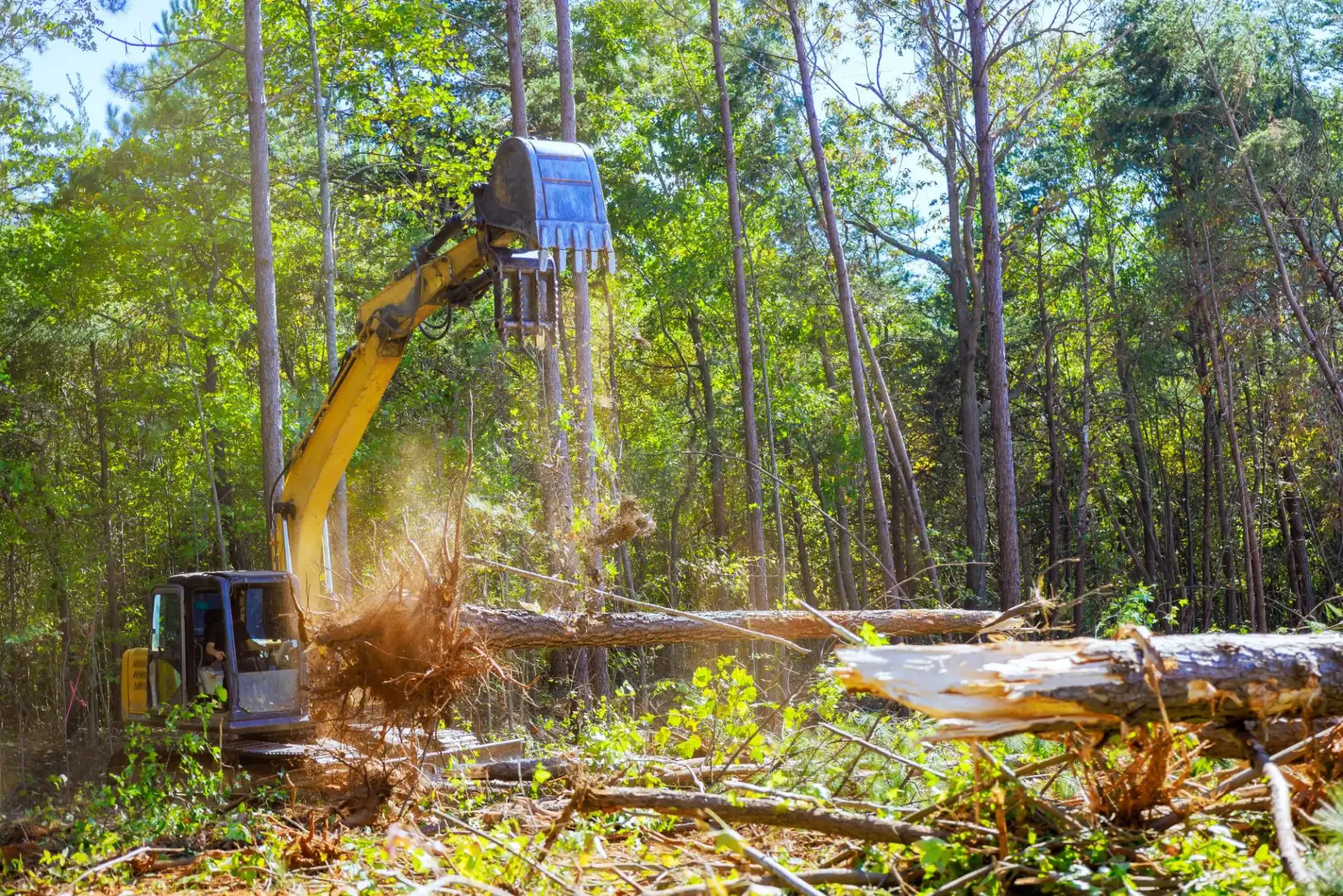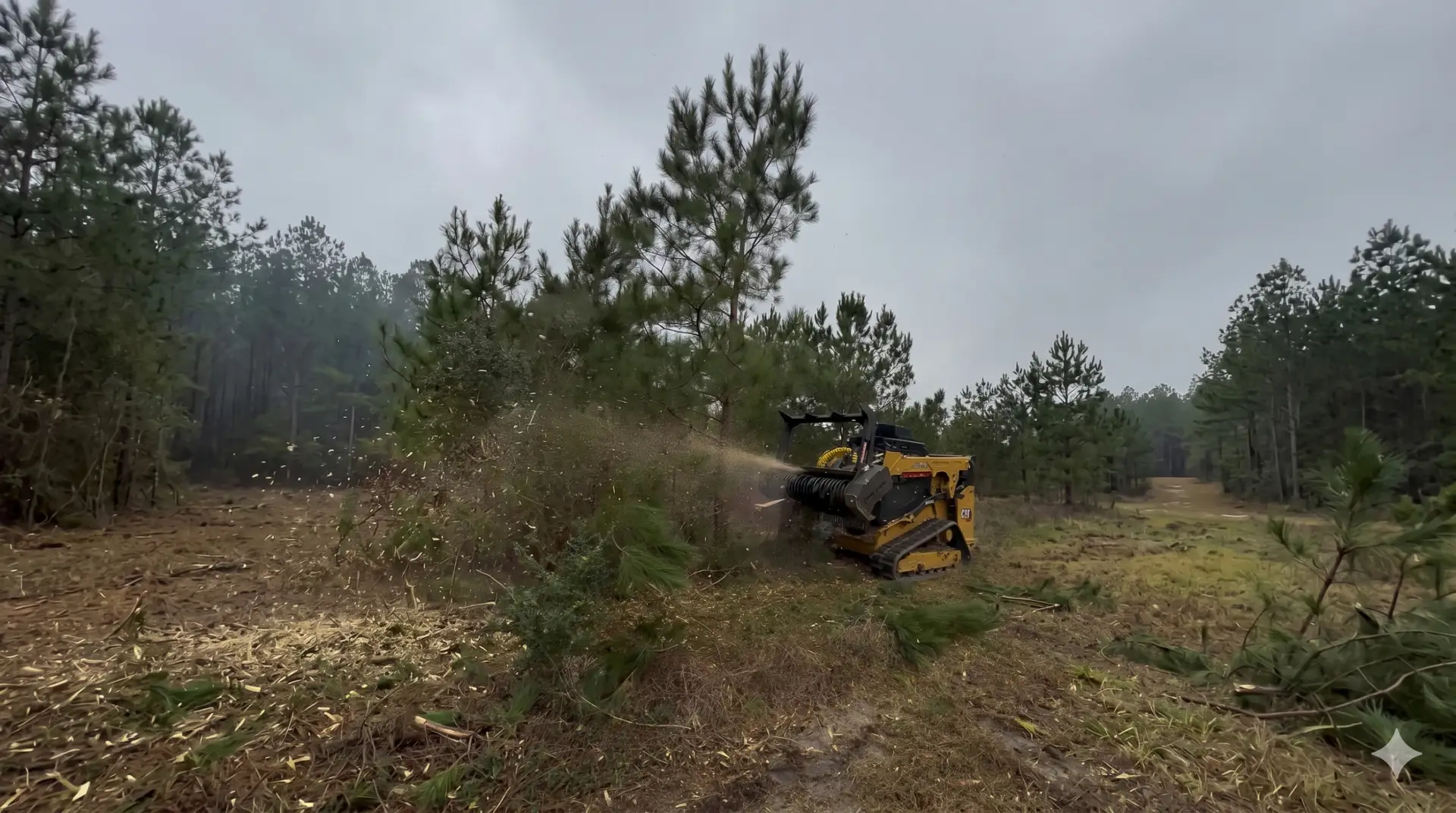
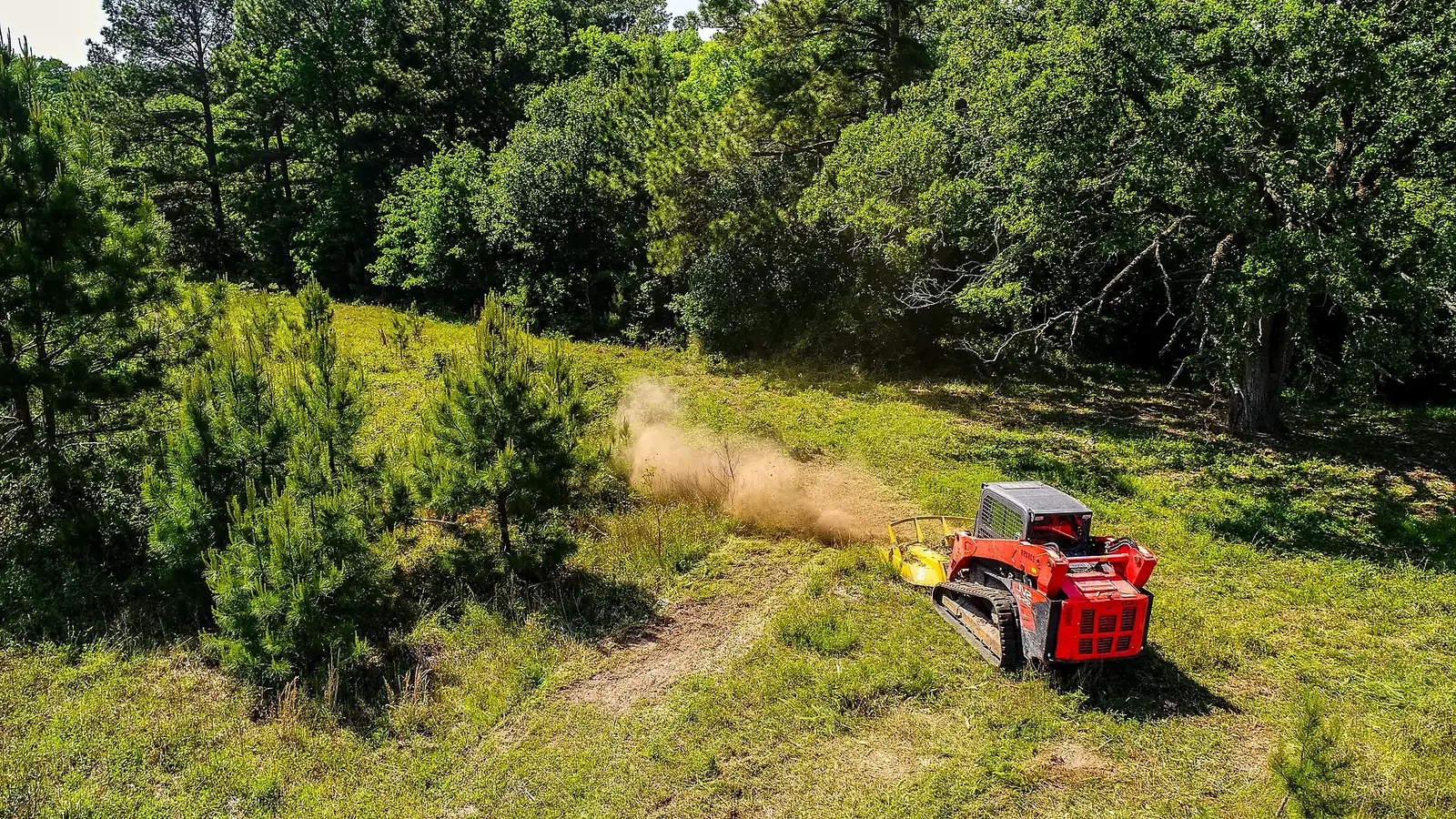
Forestry mulching turns standing brush, saplings, small trees, and other woody growth into mulch where the material already sits. A carrier machine moves across the site while a rotary drum fitted with carbide teeth grinds vegetation. Instead of creating a burn pile or loading trucks with cut material, the process leaves the processed material on the ground.
That simple description explains why forestry mulching is useful, but it does not answer the questions that matter most when you own overgrown land: Is it right for this property? What will the finished site look like? What happens to roots and stumps? How does a contractor price the work? And when does a building project require more than mulching?
This guide walks through the complete process for property owners in Greater Houston. It also explains the limits of the method, because a good clearing plan should be built around what you intend to do with the land—not around one machine.
What Is Forestry Mulching?
Forestry mulching is a mechanical vegetation-management method. In forestry research, the closely related term mastication means grinding, shredding, or chopping woody vegetation into smaller pieces and placing those pieces in contact with the soil surface. The U.S. Forest Service explains that mastication changes the form and location of biomass rather than making that biomass disappear. The material becomes a layer of woody pieces that can decompose over time (USFS, To Masticate or Not).
On a practical land-clearing project, the machine processes vegetation in place. That can eliminate several separate operations associated with conventional clearing: cutting material, moving it into piles, burning it, or loading and hauling it away. Eberly Earthworks uses a rotary drum with carbide teeth to grind trees and brush on site, leaving the resulting material across the treated area.
Forestry mulching is not the same thing as spreading bagged landscape mulch around ornamental trees. Both involve organic material at the soil surface, but the purpose, material, equipment, and site conditions differ. Landscape-mulch recommendations should not be copied blindly onto a newly mulched acreage tract.
It is also not synonymous with every form of land clearing. Forestry mulching services are one option within a larger land-management toolbox. Full clearing, tree felling, grubbing, stump grinding, dozing, excavation, and grading may be better choices—or necessary follow-up steps—depending on the planned use.
How Forestry Mulching Works, Step by Step
Although the cutting head does the visible work, a successful job begins before the drum spins. Scope, access, vegetation, sensitive areas, and the desired finish all affect the plan.
1. Define the end use
The first question is not “How many acres?” It is “What should this property do when the work is complete?” Opening a trail, reclaiming an overgrown field edge, improving access, clearing a fence line, and preparing a foundation pad are different outcomes.
If you want to walk the land, reach a back pasture, restore visibility, or reduce dense woody overgrowth, mulching may accomplish most of the immediate objective. If you plan to pour a foundation, install a road, or establish an engineered building pad, vegetation removal is only an early phase. Root removal, earthwork, drainage, compaction, or other preparation may still be required.
Mark the intended work area before the crew begins. Identify property boundaries, access routes, trees to preserve, structures, fences, wells, septic components, drainage features, overhead obstructions, and any known underground utilities. For a future build, place the proposed structure, driveway, and utility corridors on the plan as early as possible.
2. Evaluate access and ground conditions
The contractor needs a safe route from the road to the treatment area. Gate width, tight turns, narrow easements, low branches, culverts, bridges, soft ground, slopes, and nearby improvements can affect which carrier machine fits and how it can move.
The U.S. Forest Service’s technical synthesis describes skid steers, excavators, and tractors as possible carrier machines, with different front-mounted or boom-mounted cutting heads. It also emphasizes matching the equipment to the management objective and physical setting. Slope, erosion or compaction vulnerability, invasive plants, and treatment cost all belong in the site evaluation (USFS RMRS-GTR-381).
That is why two parcels of equal size may be very different jobs. One may offer a wide, firm entrance and relatively uniform brush. Another may require careful movement through a narrow opening, around improvements, and across wet or uneven ground.
3. Identify what will be mulched and what will stay
Walk the work area and distinguish target vegetation from trees or features that must remain. Forestry mulching can support selective clearing because the operator can work around retained trees and defined corridors, subject to machine access and safe operating space.
Vegetation type and density matter. Thin brush is different from interwoven vines and thick woody understory. Scattered saplings are different from closely spaced trees. Downed material, old piles, wire, rocks, construction debris, and other hidden objects can also change how the work proceeds.
The scope should say whether the goal is to process underbrush, remove selected trees, open a corridor, clear to a boundary, or create a broader open area. “Mulch the property” is too vague when valuable trees, fences, drainage areas, or future improvements are involved.
4. Process the vegetation in place
During operation, the rotary drum and carbide teeth engage standing or downed woody material. The operator reduces that material and distributes it over the treated ground rather than pushing it into a disposal pile.
Machine configuration affects the result. Forest Service research notes that cutting heads, carrier machines, particle size, and operator choices can all influence treatment outcomes. The same research also cautions that implementation details matter; there is no single configuration that is best for every objective or every site (USFS RMRS-GTR-381).
A skilled operator is not simply driving in straight lines. The work requires watching the material, the ground, nearby retained trees, obstacles, and the finish being produced. Some locations may need another pass. Others may need less traffic to reduce disturbance.
5. Review the finish and next phase
After processing, the site should be reviewed against the agreed scope. Are the desired routes open? Were marked trees retained? Is material distributed appropriately for the site? Are there areas that need separate stump treatment, conventional clearing, or earthwork?
The answer depends on the end use. A mulched trail or reclaimed overgrown area may be ready for immediate access. A future homesite is not automatically construction-ready just because the standing growth is gone. Owners planning a build should treat clearing, grubbing, drainage, and grade as connected but distinct decisions. Eberly’s guide to clearing land for building in six steps explains that broader sequence.
What the Finished Property Looks Like
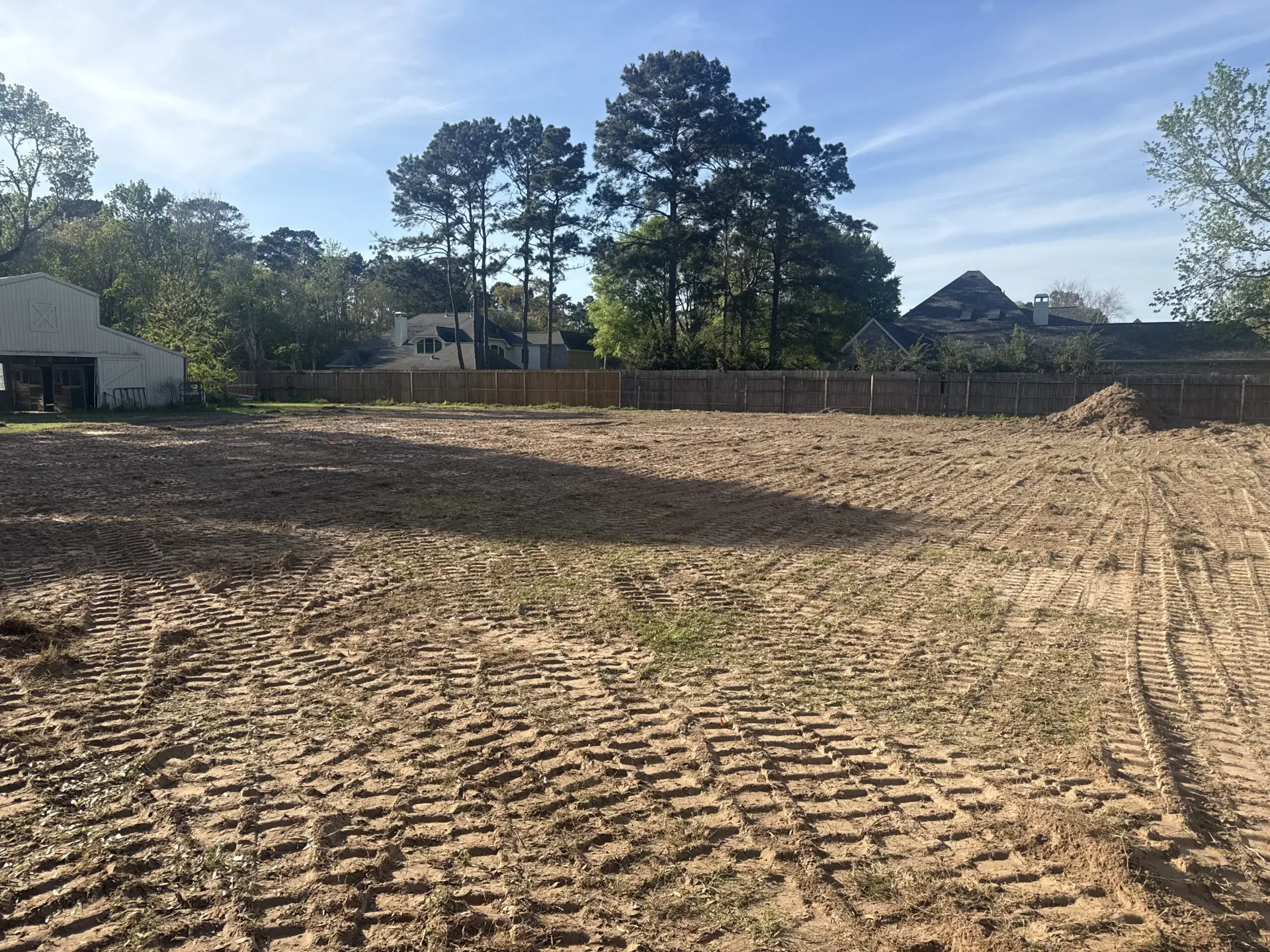
A forestry-mulched property is generally open at the surface, with processed woody material left on the ground. It does not look like a scraped, bare-earth pad, and it should not be judged by that standard.
The exact texture and distribution of the material vary with what was processed, the cutting head, the number and direction of passes, moisture, terrain, and the finish specified. Larger woody growth does not produce the same material as fine brush. A site with mixed vegetation will not have a perfectly uniform appearance.
Most importantly, the visible mulch is not proof that everything below grade has been removed. Roots generally remain, and some stump material may remain at or below the treated surface. That can be acceptable for access, selective understory management, pasture reclamation, trails, fence lines, and many general property-improvement goals. It is not the same result as grubbing.
Avoid treating mulch depth as a universal pass-or-fail number. The USDA Natural Resources Conservation Service says mulch selection and application should reflect the purpose, site conditions, material, and required duration. Its conservation standard also warns against excessively thick or tightly packed material that can create wet, low-oxygen conditions (NRCS Conservation Practice Standard 484). A forestry-mulched tract needs a site-specific finish, not a depth copied from an unrelated landscaping rule.
Why Forestry Mulching Works for Overgrown Land
Forestry mulching combines vegetation reduction and debris processing in one operation. That creates several practical advantages when the site and end goal fit the method.
It avoids routine hauling, burning, and debris piles
Traditional clearing may involve cutting or pushing vegetation, gathering it, and then deciding whether to haul it or burn it where allowed. Forestry mulching processes the targeted material on site. That means the ordinary plan does not depend on creating a burn pile or trucking the processed vegetation away.
This does not mean every object on a property can be mulched. Trash, wire, concrete, metal, and other nonvegetative debris require separate handling. Large material outside the machine’s appropriate scope may also need another method. The advantage applies to the suitable woody vegetation included in the project.
It can be a lower-impact option
Because the method processes material where it stands instead of uprooting every plant and pushing large piles across the site, it can leave more of the soil surface in place than aggressive dozing or grubbing. This is especially useful when the goal is to open overgrown land rather than strip it to bare soil.
“Lower impact” does not mean “no impact.” Heavy equipment still travels across the property. Soil compaction, rutting, erosion, and damage to retained vegetation remain planning concerns. Forest Service guidance specifically recommends considering soil vulnerability, slope, equipment configuration, and the number of machine passes (USFS RMRS-GTR-381). Conditions on the day of work matter too, particularly where ground is soft.
It keeps organic material on the site
The processed vegetation remains as organic material at the surface. The NRCS identifies moisture management, erosion reduction, plant health, and maintaining or increasing organic matter among potential purposes of mulching, while emphasizing that results depend on the material and site (NRCS Standard 484).
Those are potential functions, not automatic guarantees. The layer must suit the location, and drainage still matters. A wet, poorly drained area should not be treated as though more material is always better.
It supports selective property improvement
Many owners do not want every tree removed. They want access under a canopy, visibility along a fence, an open path, space around an improvement, or control over encroaching brush. Mulching can be scoped around vegetation that should remain when the machine has room to work safely.
Selectivity starts with clear markings and communication. Retained trees, buffers, and no-go areas should be identified before work, not while the operator is already moving through dense growth.
It reduces the number of debris-handling decisions
On-site processing simplifies one major part of project planning: what to do with woody debris. There is no ordinary need to schedule pile burning or pay to transport every processed branch and sapling. That can make a project easier to coordinate, although the total cost still depends on what is actually present and what finished condition is required.
Forestry Mulching vs. Traditional Land Clearing
Neither method is universally better. They produce different conditions and solve different problems.
Forestry mulching is often a strong fit when the goal is to:
- Reclaim overgrown areas without scraping the entire surface bare
- Open trails, lanes, or access routes
- Clear brush along fence lines or property edges
- Reduce dense understory while retaining selected trees
- Process suitable woody material without hauling or burning it
- Improve general access and visibility on an overgrown tract
Traditional clearing methods may be the better fit when the project requires:
- Full removal of root systems in a construction footprint
- A bare-earth condition for immediate earthwork
- Removal of material the mulcher should not process
- Major tree and stump removal
- Excavation, cut-and-fill work, or engineered site preparation
- A finish defined by construction plans rather than vegetation management
Many projects use a combination. Mulching may open the property and process brush, while an excavator grubs the future foundation area. Grading may follow after the vegetation and roots that conflict with construction are removed. Eberly’s complete guide to land-clearing methods and equipment provides a broader comparison.
Forestry Mulching Is Not Root Removal
This limitation deserves its own section because it changes project scope and budget.
A mulcher works primarily at and above the ground surface. It can process woody growth and reduce exposed stump material within the agreed scope, but it does not fully extract underground root systems. Roots that remain can matter when the soil will support a building, pavement, utilities, or another improvement.
For a foundation pad, ask the builder, engineer, or site contractor what condition is required. Grubbing may be necessary to pull stumps and root masses. Excavation may be needed to remove unsuitable material. Fill placement, compaction, elevation, and drainage may need to follow plans or specifications. Those are not interchangeable with mulching.
Eberly Earthworks can coordinate the clearing decision with site preparation and grading when the land is moving toward construction. The important point is to price the complete path to the intended result. A low clearing quote is not useful if it omits the root removal and earthwork the next contractor will require.
What Forestry Mulching Costs
There is no honest universal price for forestry mulching without understanding the property. Acreage matters, but acreage alone does not measure machine time, access difficulty, vegetation, obstacles, or the requested finish.
A responsible estimate should account for the factors below.
Vegetation density and composition
Dense, interwoven woody growth requires a different effort than scattered brush. Tree size, spacing, vines, downed material, old piles, and the amount of understory all influence how the machine can advance. What satellite imagery shows as “wooded” may contain very different conditions beneath the canopy.
Site access
Transport and machine access begin at the road. Gates, turning radius, overhead clearance, bridges, culverts, narrow driveways, easements, fences, and soft entry points can affect mobilization and equipment choice. Limited access may call for a different machine or more careful staging.
Terrain and ground conditions
Slope, low areas, drainage features, wet ground, erosion risk, rocks, and uneven terrain can slow movement or change the operating plan. A site visit helps identify conditions that are easy to miss in photos.
Debris handling
A basic advantage of forestry mulching is that suitable vegetation is processed on site. However, a property may also contain material that cannot or should not go through the mulcher. Trash, wire, metal, concrete, and mixed demolition debris need a separate plan. If the owner requests collection, relocation, or haul-off for any material, that changes the scope.
Stump and root treatment
The estimate should clearly state what happens to stumps and what does not. If the end goal requires stump grinding, grubbing, or excavation beyond normal mulching, that work must be identified. Construction areas often have a different requirement from trails or pasture edges.
Selectivity and finish expectations
Working around many retained trees, improvements, or precisely marked buffers can require more maneuvering than broad treatment. Likewise, a rough access opening and a refined finish are not the same scope. The quote should define what the completed area is expected to look like.
Mobilization and total project scope
The equipment has to be transported and staged safely. Combining related work may affect the overall plan. For example, a property could need mulching in one area, full land clearing in another, and grading at the future building location.
Rather than relying on an invented per-acre figure, ask for an on-site evaluation and a written scope. The most useful price is the total for the condition you actually need, with debris handling and stump treatment stated clearly.
How to Compare Forestry Mulching Quotes
Two totals are comparable only when they describe the same work. Before choosing a contractor, confirm that each proposal answers these questions:
- What exact area is included? Use marked boundaries, a map, or identifiable landmarks.
- What vegetation will be processed? Clarify brush, saplings, selected trees, downed material, and exclusions.
- What will remain? Identify protected trees, buffers, stumps, roots, piles, and nonvegetative debris.
- How will debris be handled? The proposal should say what is mulched in place and whether anything is moved or hauled.
- What stump treatment is included? Do not assume “cleared” means root systems are removed.
- What finish is expected? Define access, visibility, material distribution, and any areas requiring a different method.
- Are access constraints accounted for? Confirm the route, gates, culverts, overhead clearance, and staging area.
- What follows the mulching? If the site will be built on, identify grubbing, excavation, grading, and drainage as separate or included phases.
A clear quote protects both the owner and contractor. It also prevents the common mistake of selecting a low number that describes only part of the desired outcome.
Planning Around Soil, Water, and Existing Trees
Mulch can help cover exposed soil, but it is not a substitute for drainage planning or erosion control design. Water still follows grade. Concentrated runoff, channels, steep slopes, and poorly drained areas need specific attention.
The NRCS standard recommends evaluating how mulch affects infiltration, runoff, erosion, evaporation, and soil conditions. It also notes that some material can create problems in aquatic environments or move as waterborne debris, depending on placement (NRCS Standard 484). If the work approaches a creek, pond edge, drainage channel, wetland, or other regulated or sensitive area, verify applicable requirements before work begins.
Protecting retained trees also requires more than avoiding their trunks. Machine traffic and material placement can affect root zones. Penn State Extension’s landscape-tree guidance warns that excessive mulch or material piled against a trunk can restrict oxygen and keep trunk tissue wet. It recommends keeping the root flare visible in the landscape-tree context (Penn State Extension).
That publication gives specific depths for maintained landscape beds, but those numbers are not a universal forestry-mulching specification. On acreage, distribution should reflect material size, drainage, retained vegetation, future use, and site conditions. The transferable lesson is simpler: do not assume that deeper is always better, and do not bury the trunks of trees you intend to keep.
Is Forestry Mulching Right for Your Property?
Forestry mulching is usually worth considering when the primary problem is woody overgrowth and the desired result does not require every root removed. It can be especially practical for opening land, restoring access, treating brush around selected trees, and avoiding routine hauling or burning of suitable vegetation.
It may not be the complete answer when the site must become a foundation pad, road base, finished grade, or fully grubbed development area. It may also be inappropriate for mixed debris, areas the machine cannot safely access, or sensitive locations that require a different plan.
Use this short decision sequence:
- What is the land for after clearing? Access and vegetation management point toward mulching; structural support and earthwork require more.
- What must remain? Mark trees, structures, buffers, and utilities.
- What is growing there? Density, size, and hidden debris affect feasibility and cost.
- Can equipment reach it safely? Review gates, turns, ground conditions, and crossings.
- What must happen below grade? If roots conflict with the next use, include grubbing or excavation.
- What should happen to the processed material? Agree on distribution and any special handling.
A site walkthrough converts these questions into an accurate scope.
Forestry Mulching in Greater Houston
Eberly Earthworks serves property owners across Greater Houston and surrounding communities, including Conroe, The Woodlands, Spring, Magnolia, Humble, Kingwood, Willis, Montgomery, Cleveland, Dayton, Livingston, Navasota, and College Station.
Properties across that service area vary widely: residential lots, rural acreage, fence lines, access routes, wooded tracts, and land intended for future construction. The appropriate clearing method depends on the actual vegetation, access, ground conditions, and next use—not just the city name or parcel size.
If you are still comparing options, the Eberly Earthworks blog library covers related land-clearing and site-preparation topics. For a property-specific answer, an on-site review is more useful than a generic online estimate.
Get a Forestry Mulching Plan Built Around Your Land
Forestry mulching works best when the contractor knows what you want to preserve, what you want opened, and what the land must support afterward. Eberly Earthworks can walk the site, review access and vegetation, explain what mulching will and will not remove, and build a scope around the finished condition you need.
If your property is overgrown and you want to avoid hauling, burning, or leaving debris piles, contact Eberly Earthworks for a forestry mulching estimate. Bring your property boundaries, future-use plans, and any known utility or access information to the walkthrough. You will get a clearer answer on method, cost factors, stump treatment, and whether any grubbing or grading should follow.
Request a forestry mulching consultation with Eberly Earthworks and turn an overgrown property into land you can access, manage, and move forward with.
Frequently Asked Questions
What is forestry mulching?
Forestry mulching is a mechanical process that grinds or shreds trees, brush, saplings, and other suitable woody vegetation where it stands. The processed material remains on the ground rather than being routinely piled, burned, or hauled away.
How does a forestry mulcher work?
A carrier machine moves a cutting head through the treatment area. Eberly Earthworks uses a rotary drum with carbide teeth to process vegetation. The operator controls the passes and finish based on the material, terrain, retained features, and agreed scope.
Does forestry mulching remove roots and stumps?
It does not fully remove underground root systems. Exposed stump material may be processed within the project scope, but roots generally remain. If the land will support a foundation, roadway, utilities, or other construction, grubbing, excavation, or grading may be required.
How much does forestry mulching cost?
Cost depends on vegetation density, access, terrain and ground conditions, debris handling, stump treatment, the level of selectivity, finish expectations, and mobilization. Acreage alone is not enough for an accurate price. An on-site evaluation is the best way to establish a usable project total.
Is forestry mulching cheaper than traditional land clearing?
It can reduce costs tied to piling, burning, loading, and hauling suitable woody vegetation because the material is processed in place. However, it is not automatically cheaper for every project. If the end use requires full root removal, extensive debris handling, or grading, those additional phases must be included when comparing totals.
Is forestry mulching good for the soil?
Leaving organic material on the surface can support purposes such as soil cover, moisture management, erosion reduction, and adding organic matter. Results are site-specific. Material distribution, drainage, soil vulnerability, and equipment traffic all matter, and an excessively thick or tightly packed layer can create problems.
Can forestry mulching prepare a lot for a house foundation?
It can be an effective first step for removing brush and woody growth, but mulching alone does not create a construction-ready foundation pad. Roots, unsuitable material, elevation, drainage, fill, and compaction may need to be addressed through grubbing, excavation, and site preparation.
What happens to the mulch after the job?
The processed woody material stays on the treated ground and decomposes over time. Its appearance and breakdown rate vary with particle size, material, moisture, and site conditions. Distribution should be evaluated for the intended use, drainage, and retained trees rather than set to one universal depth.
What should I do before a forestry mulching estimate?
Know the property boundaries and intended end use. Mark important trees and no-go areas, identify gates and access constraints, note wells, septic components, drainage features, structures, fences, and known utilities, and explain whether construction or grading will follow. That information helps the contractor quote the right scope.